

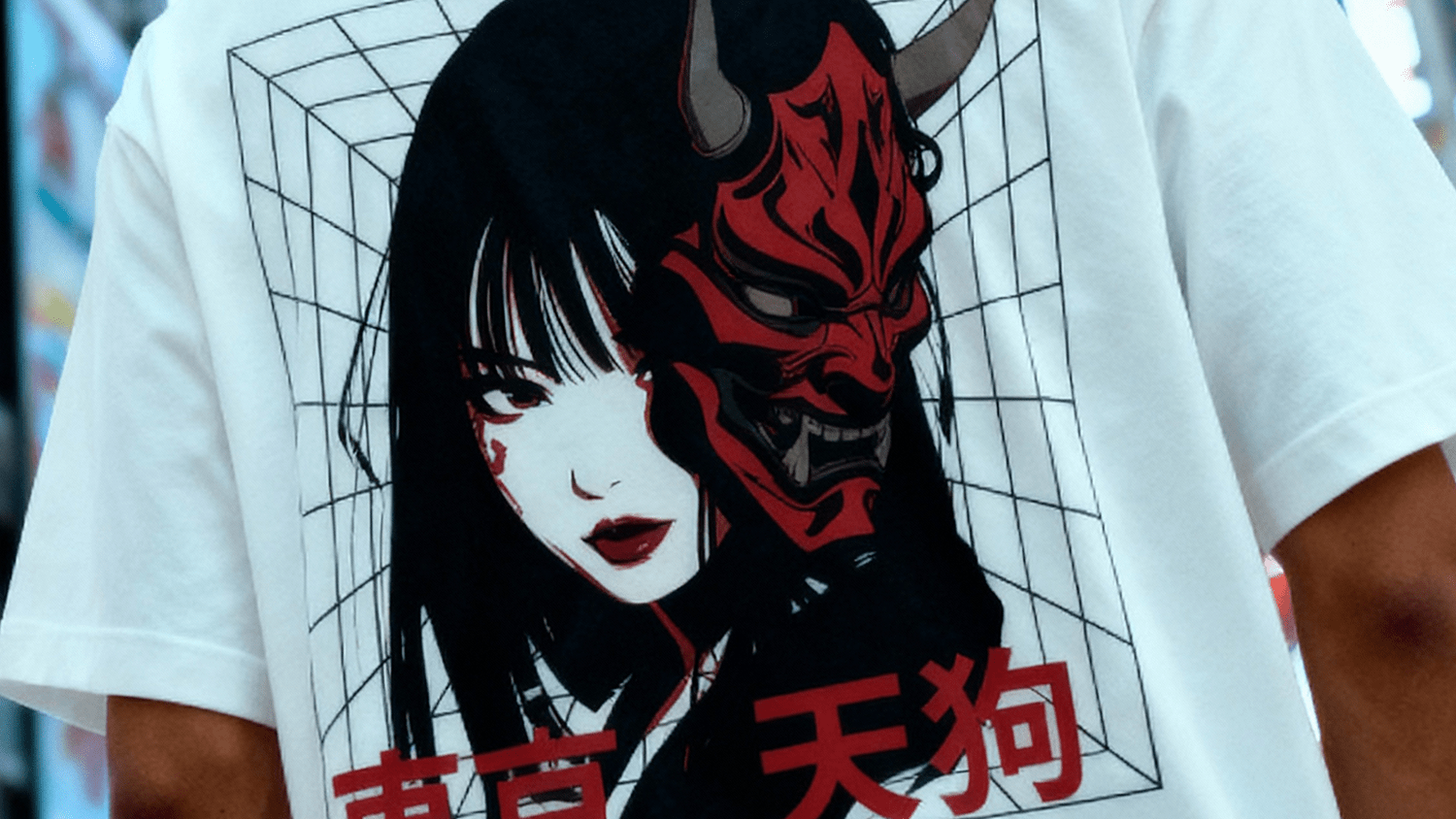
She didn't choose to become a demon.
Jealousy did that for her. Slowly. A woman consumed by an obsession no amount of reason could stop. Until her face was no longer hers.
The Hannya mask captures that exact moment. Not before. Not after. The precise instant a person becomes something else.
That's why it has fascinated for seven centuries. And why it's everywhere: on Noh stages, tattooed on the skin of irezumi masters, painted on walls in Shinjuku, and today on the shoulders of people who wear the symbol without needing to explain it.
What Is the Hannya Mask?

Noh theater is one of the oldest performance forms in the world. Codified in the 14th and 15th centuries by Zeami Motokiyo, it relies on reduction: minimal sets, sparse movement, hand-carved masks to embody emotional states the human face alone cannot reproduce.
The Hannya mask is one of its most complex pieces.
It represents a female spirit transformed into a demon by jealousy or obsession. The name comes from the Sanskrit "prajna" (wisdom), applied here with bitter irony. The woman who becomes Hannya hasn't found wisdom. She's been separated from it by something stronger than reason.
Look at the mask closely. Two gold horns. A wide open mouth with metal fangs. Fixed golden eyes that will never blink. But look at the brow. There's still human pain in those carved lines. Grief preserved intentionally by the best Noh craftsmen for centuries.
It's not just a demon. It's someone who still knows what they lost.
The actor wearing the mask must inhabit both at once: the woman and the thing she became. The mask doesn't forgive. It shows.
Why the Hannya Travels Beyond Noh

The Noh stage is just a starting point.
For centuries, the Hannya has migrated from theater to skin to street. In the tradition of Japanese tattooing, irezumi, it's one of the most requested motifs since the Edo period. Its meaning in that context is inverted: the demon becomes a protector.
Wearing the Hannya signals that you've been through something intense. A dark period. An obsession. A transformation you didn't choose but survived. Masters like Horiyoshi III have spent decades on this motif precisely because it captures emotional states few images can match.
In dark manga and anime, the Hannya archetype runs as a constant current. The line between human and demon, transformation driven by a curse or emotion, a face that changes but keeps something human underneath: it's everywhere in Demon Slayer, Jujutsu Kaisen, Naruto. Not always cited directly. Present in the structure of every transformation arc.
Japanese Streetwear and the Logic of the Symbol
Japanese streetwear and Hannya culture share the same foundation: clothing as coded language.
The Ura-Harajuku movement of the 1990s built an entire aesthetic around this. Dense layers of symbols, references crossing tradition and pop culture, pieces you could only fully appreciate if you knew the codes. Nigo, Jun Takahashi, Hiroshi Fujiwara: designers who constructed whole universes on that logic.
The Hannya fits that lineage naturally.
Up close it's seven centuries of mythology condensed into one face. From a distance it's a graphic image that stops people in their tracks. The surface is accessible to anyone. The depth rewards those who look.
For fans of dark anime, serious Japanese culture, and wearing references that mean something: this is exactly what you want from a garment. Not decoration. Not merch. A signal.
The Tokyo Tengu Hannya Tee
Built from the Noh mask itself. Not a stylized version. Not softened for accessibility. The actual mask. Horns, open mouth, golden eyes, and the human grief those craftsmen preserved in lacquered wood for generations.
Available in white. 230 GSM heavyweight carded cotton. Oversized cut with dropped shoulders. High-definition DTF print that captures every detail of the mask on white cotton with nothing lost, nothing simplified.
A piece for those who know what this mask actually represents. Not a costume. A wearable statement.
What You're Carrying

You don't need to explain Noh, Irezumi, or Zeami Motokiyo for the tee to work. The visual force speaks on its own. But for those who recognize the mask's structure, who see why the brow is carved that way, who know the difference between a demon and someone who became one: there's another layer.
That's the IYKYK effect.
Wearing the Hannya means accepting the symbol as it is. Beauty and pain in the same face, woven so tight you can't pull them apart.
Seven centuries of culture on your shoulders.
230 grams.
You feel it.

Leave a comment
This site is protected by hCaptcha and the hCaptcha Privacy Policy and Terms of Service apply.